



Setting Realistic SEO Expectations: Market SEO Timelines
If you’ve ever asked yourself “how long does SEO take” or thought “when will I finally see results from my search engine optimization activities?”, you are in the same boat as hundreds of other business owners, especially if you’re new to digital and online marketing.
You may be surprised to learn the truth about what you can expect regarding the timeline of these results, and it is likely different than what you have been led to believe by SEO agencies who have a “one shoe fits all approach” to getting quick results. In this extensive guide, we will walk you through realistic SEO timelines, help you understand what will affect your results, and most importantly demonstrate to you how to set proper expectations around SEO results and keep you motivated throughout the whole process.
Why SEO Takes Time: Understanding the Foundation
Before we look at exact timelines, it’s important to know why SEO will not happen overnight. In contrast to paid ads, where traffic is produced immediately, optimization is primarily about building trust and authority, neither of which will happen quickly.
Everyday, search engines like Google process over 8.5 billion searches, and their algorithms have come a long way in differentiating quick fixes from real value. Essentially, when someone takes action on an SEO recommendation, they are asking Google to trust the recommended website enough to suggest it to their searchers. This is something that will take time.
Consider what it takes to build reputation in your local community. Would you expect to become the most trusted local business within a month of operating? Search engines are no different; they need to see consistent, valuable contributions before they feel comfortable recommending the website to searchers.
The Realistic SEO Timeline: What to Expect Month by Month
SEO is a long-term approach rather than an instantaneous solution. SEO develops in stages, each stage relies on the performance of the previous stage. In the table below, you will find what to focus on, and what reasonable expectations you might have at various stages of the SEO process.
| Phase | Focus Areas | Realistic Expectations / Indicators |
| Months 1–3: Foundation Building Phase | – Comprehensive keyword research – Fixing technical SEO (site speed, mobile optimization, crawl errors) – Creating high-quality, optimized content – Setting up analytics and tracking systems – Building initial site structure & navigation | – Minimal ranking improvements for competitive keywords – Some ranking gains for long-tail keywords – Increased crawling by search engines – Baseline establishment in Google Search Console |
| Months 4–6: Early Momentum Phase | – Continue optimizing content – Monitor keyword rankings & impressions – Improve CTR with better content credibility – Expand indexed pages | – First noticeable ranking improvements – Gradual increase in organic impressions – Better rankings for long-tail keywords – Improved click-through rates – 10–20% increase in organic traffic vs. baseline – Competitive keywords appear on pages 2–3 – Increased time on site from organic visitors |
| Months 7–12: Significant Growth Phase | – Maintain consistent content creation – Build backlinks naturally – Optimize for authority & trust | – 30–100% increase in organic traffic – First-page rankings for some target keywords – Increased domain authority & credibility – Natural backlink acquisition – Noticeable impact on leads, sales, inquiries |
| Year 2 and Beyond: Sustained Growth & Authority | – Scale content strategy – Strengthen brand presence – Leverage SEO as growth engine | – Dominant rankings for primary keywords – Consistent & predictable traffic growth – Strong brand authority in SERPs – Faster ranking for new content – SEO becomes major revenue driver |
Factors That Influence Your SEO Timelines
Website Age and Starting Point
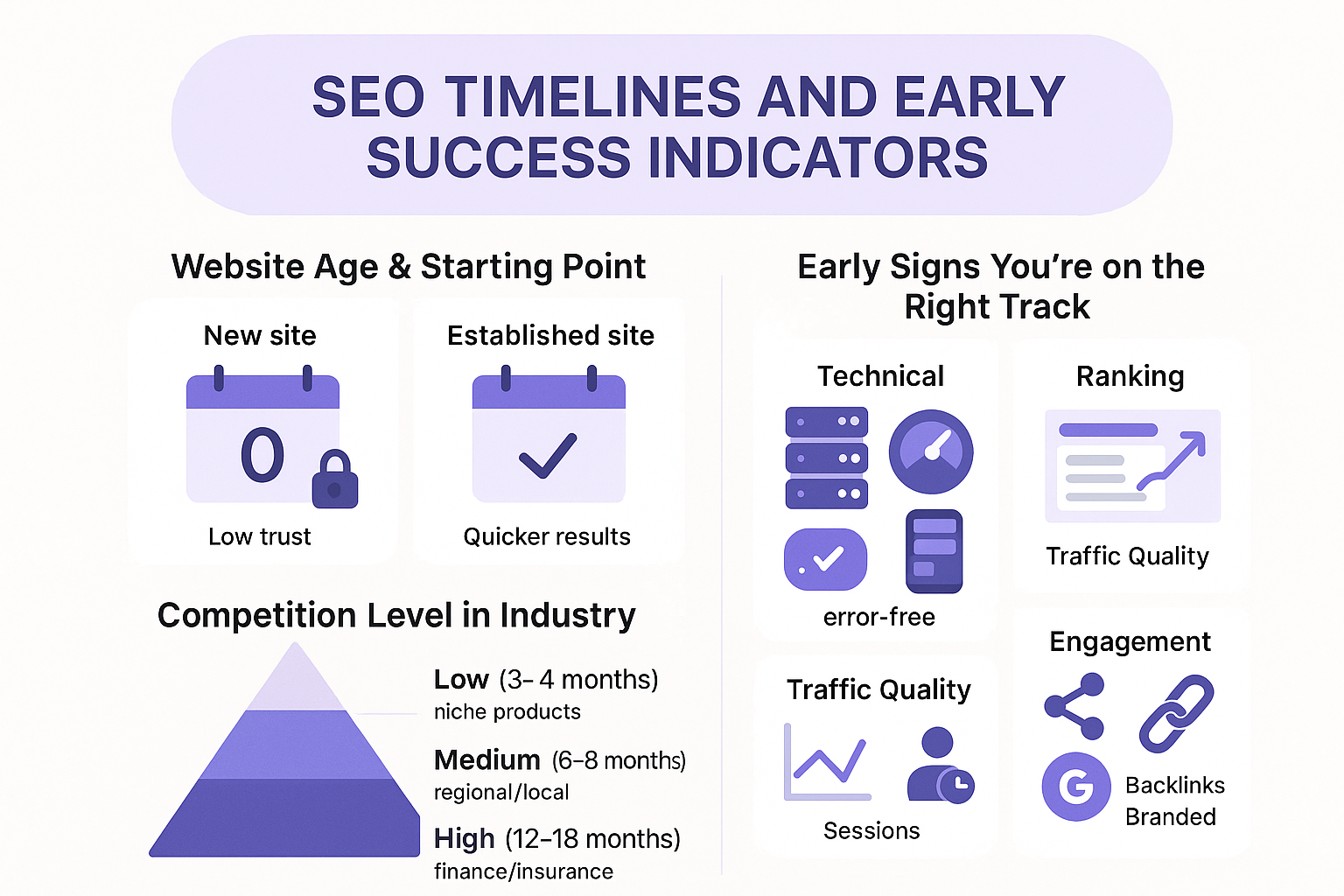
It’s necessary to comprehend what can affect your SEO timeline so you can manage your expectations accordingly. That’s because brand new sites will take longer—most often, six to twelve months to start seeing substantial results. The reason is that search engines have no history or authority to reference on brand new domains, which means trust has to be built over time. Established site may obtain some results after only three to six months, particularly if they add a few obvious technical fixes or optimize some areas where there is content but just underdeveloped.
Competition Level in Your Industry
The competitive nature of an industry usually defines the speed of results more than any other factor as a rule. Companies that operate in a virtually non-competitive niche, like a specialist service B2B or a specific product category, may begin to see rankings in three to four months. In lower competitive environments, like local services or more regional e-commerce, you can begin to expect ranking progress in six to eight months of continuous optimization. If a company operates in a highly competitive industry—like insurance, finance, law, or a large e-commerce category—it could take a minimum of twelve to eighteen months of continuous optimization to see any meaningful rankings.
Early Signs You’re on the Right Track
While waiting for major results, watch for these positive indicators that your SEO patience timeline is paying off:
| Category | Positive Indicators |
| Technical Indicators | – Increased pages crawled & indexed by Google – Improved site speed scores – Reduced crawl errors in Google Search Console – Better mobile usability ratings |
| Ranking Indicators | – Appearance in search results for brand name – Rankings for long-tail keywords – Movement from page 5+ to page 2–3 for target keywords – Increased impression volume in Search Console |
| Traffic Quality Indicators | – Longer average session duration from organic visitors – Lower bounce rate for organic traffic – Increased pages per session – Growing return visitor percentage |
| Engagement Indicators | – Natural social sharing of your content – Organic backlinks from other websites – Direct traffic increases (brand awareness impact) – Increased branded search queries |
What to Do While Waiting for SEO Results
What to Engage in While Awaiting SEO Outcomes
The timeline for SEO can often feel slow-moving and infuriating, particularly in the earlier months when the substantial change has not happened yet. However, this time is not wasted; it is your first opportunity to help build momentum and achieve true growth in the long run. By staying busy and strategic, your website will be in a great position for success once rankings and traffic start to rise.
Maintain Regular Content Creation
When it comes to SEO, consistent content creation will beat short phenomena every time. Many people overlook this factor, but even though you may only produce a new blog or resource piece once a week, you can still produce effective content for search engines and readers. It does not have to be high quality but it can still attract quality traffic. To start, simply produce a blog post, guide, or resource that actually does help the audience tackle a challenge or question. At the end of the day, anything you publish becomes a long-term asset that can yield organic traffic long before you realize it.
Establish Relationships and Build Authority
Authority is one of the biggest ranking signals in SEO, and establishing authority takes time. You can use this step in your SEO timeline to develop partnerships and engage with people within your industry or community. Be a part of online conversation or discussions, work with complementary businesses, and promote your original content once you see it’s being viewed frequently.
Stay On Top of Performance and Make Changes
While you wait for the positive effects of your SEO improvement, monitor your website closely using tools to track how its performance is changing. This monitoring can take the form of Google Analytics, Google Search Console, and keyword tracking software that signals trends and allows you to act quickly. Look specifically at:
1. Organic traffic growth over time
2. Keyword ranking movements
3. Click through rates from search results
4. Conversion rates from organic visitors
5. Page speed and mobile usability
6. Overall technical health scores
These are leading indicators and will tell you if things are trending in your direction even before and influx of traffic based on rankings.
Increase Your SEO Knowledge
Finally, don’t ignore learning. The wait in the SEO timeline is perfect for increasing your knowledge of SEO best practices and learning about Google algorithm updates and actively studying your competitors’ successful strategies. The better you become at knowledge improvement the more equipped you will be to adapt and improve performance when your site starts ranking higher.
Common Mistakes That Delay SEO Results
Even with the right intentions, many businesses unconsciously delay their SEO progress by falling into traps they could have simply avoided. Knowing the mistakes and how to avoid them can ease your timeline and make your SEO work so much better.
Impatience and Constantly Changing Strategy
One of the most common mistakes made, is abandoning a strategy quickly. SEO is a long-term investment, it can take up to months before improvements in ranking and traffic can be noticed. Changing tactics every few weeks fails to let search engines evaluate your site properly while also delaying results.
Vanity Metrics
As marketers, we like high rankings and traffic, however if they do not convert into leads or sales that does not help move the business forward. For example, ranking for broad, high volume keywords will bring visitors but not necessary buyers.
Overlooking the Technical Basics
Technical problems can derail even the best content. Your site may be slow to load, have broken links or crawl errors, or perform poorly on mobile devices. These technical problems inhibit search engines’ ability to crawl and rank your content. Technical SEO is the bedrock of your website; without it, the rest of your marketing strategy will collapse. SEOAnt’s audit tool will catch crawl errors, broken links, missing tags, and slow-loading pages, so you have a checklist of priority items to remove any obstruction to your SEO progress.
Keyword Stuffing and Over-Optimization
Those days of stuffing your SEO keywords into every line of your content are over. Today, keyword stuffing is a signal of poor content to search engines and an aggravation to the reader’s experience. The same goes for over-optimization. Stuffing a keyword into every image and header, or forcing it into your URL will often create negative ranking signals that will lower your content.
Neglecting User Experience (UX)
Search engines are rewarding websites that deliver excellent user experiences more than ever. If visitors navigate to your various pages but leave quickly because of slow load times, confusing navigation, or insufficient product detail, your rankings will eventually suffer. SEO and UX now go together. In this case, SEOAnt features monitoring of page performance metrics, such as site speed and mobile optimization, that provides recommendations to enhance user-friendly navigation, level of product detail, and mobile shopping experiences—all benefiting SEO.
When to Be Concerned About Your SEO Timelines
While patience is crucial, there are legitimate red flags that might indicate problems with your SEO strategy:
After 6 Months With Professional Help
If you’re working with an experienced SEO professional or agency and see absolutely no improvement in rankings, traffic, or technical metrics after six months, it’s worth evaluating your approach.
After 12 Months of Consistent Effort
Twelve months of consistent, proper SEO implementation should show measurable results in any industry. If you’re seeing no progress after a full year, consider getting a professional audit of your strategy.
Declining Performance
Sudden drops in traffic or rankings could indicate technical issues, penalties, or algorithm changes affecting your site. Address these immediately rather than waiting for natural recovery.
Your Next Steps: Making the Most of Your SEO Timeline
Now that you understand realistic SEO expectations and typical timelines, here’s how to move forward productively:
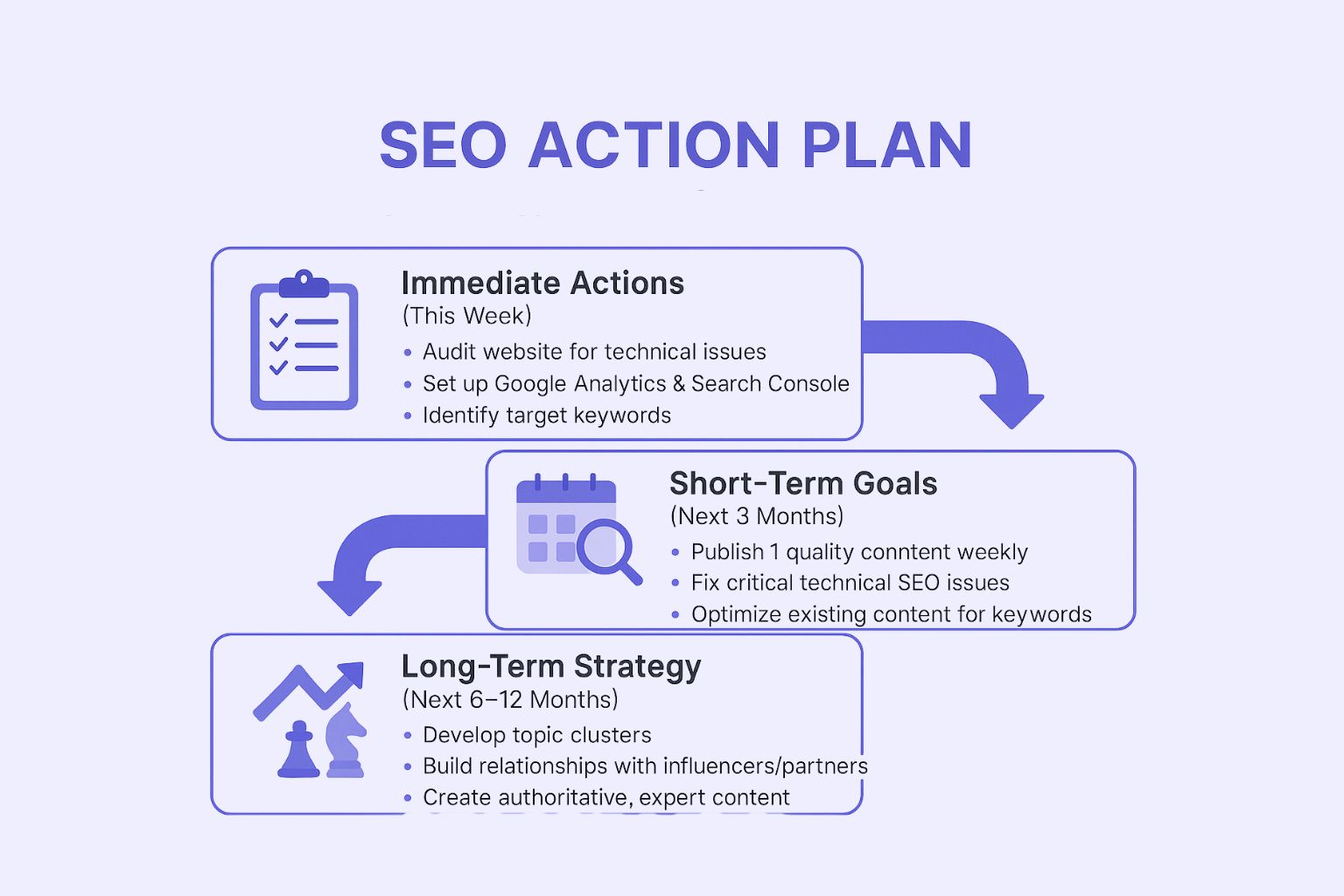
Immediate Actions (This Week)
- Audit your current website for basic technical issues
- Set up Google Analytics and Search Console if you haven’t already
- Identify your primary target keywords for the next 3 months
- Create a content calendar for consistent publishing
Short-Term Goals (Next 3 Months)
- Publish at least one high-quality piece of content weekly
- Fix all critical technical SEO issues
- Optimize existing content for target keywords
- Build a system for tracking progress and metrics
Long-Term Strategy (Next 6-12 Months)
- Develop topic clusters around your main business themes
- Build relationships with industry influencers and other businesses
- Create comprehensive, authoritative content that establishes expertise
- Continuously monitor and adjust based on performance data
Conclusion: Embracing the SEO Journey
Setting realistic SEO expectations does not mean you’re going to check your ambitions at the door. Rather, it is about having an understanding of the process, so you can birth that commitment through the entire journey. The companies that prosper with SEO are the businesses that treat it like a long-term growth strategy—not just a short term fix for your immediate traffic needs.
Since SEO timeframe expectations will differ largely based on your starting place, level of competition, and quality of implementation, use the frameworks in this guide as a general rule of thumb. It’s okay if your unique setup takes more or less time than average; don’t be dismayed!
Ultimately, it isn’t just knowing how long does SEO take, but it’s knowing HOW to effectively use that time. Commit to adding value for your audience, building a technically solid website, and showing up consistently; and the results will come. And when they do, you’ll have a much better system for sustainable growth for your business, that is worth the initial wait.
So, today is the day—start executing these same strategies today and one year from now, you’ll be glad you got off and running using realistic expectations and the commitment to do it the right way.
Understanding Global E-commerce Customer Journeys
In our interconnected digital marketplace today, 68% of online experiences begin with search engines all over the world, yet most e-commerce companies struggle with the understanding of how customers actually search for and buy their products. Whether you’re developing your first online store, or extending a brick-and-mortar store into international e-commerce, understanding the E-commerce customer journeys is the key to on-going growth and success.
This guide will take you through the elements of customer search behavior, discuss how cultural norms can affect e-commerce customer online buying behavior across global markets, and provide useful tools for maximizing your e-commerce strategy in general. By understanding these global E-commerce customer journeys you will be able to develop targeted marketing plans, increase conversion rates and build lasting customer relationships across the globe.
What is the E-commerce Customer Journey in Today’s Global Market?
The e-commerce customer journey includes the entire path a potential customer takes from recognizing a need, through the purchase and beyond. Unlike a conventional linear sales funnel, today’s customer search behavior is a complex journey with many touchpoints that differ greatly in markets and cultures around the world.
The stages of the digital buyer journey are connected, but they are often not linear; customers move back and forth between the research, comparison, and decision-making phases. To guide and support the e-commerce buyer journey, it’s important to understand that complexity when developing an international marketing strategy that is relevant to global audiences.
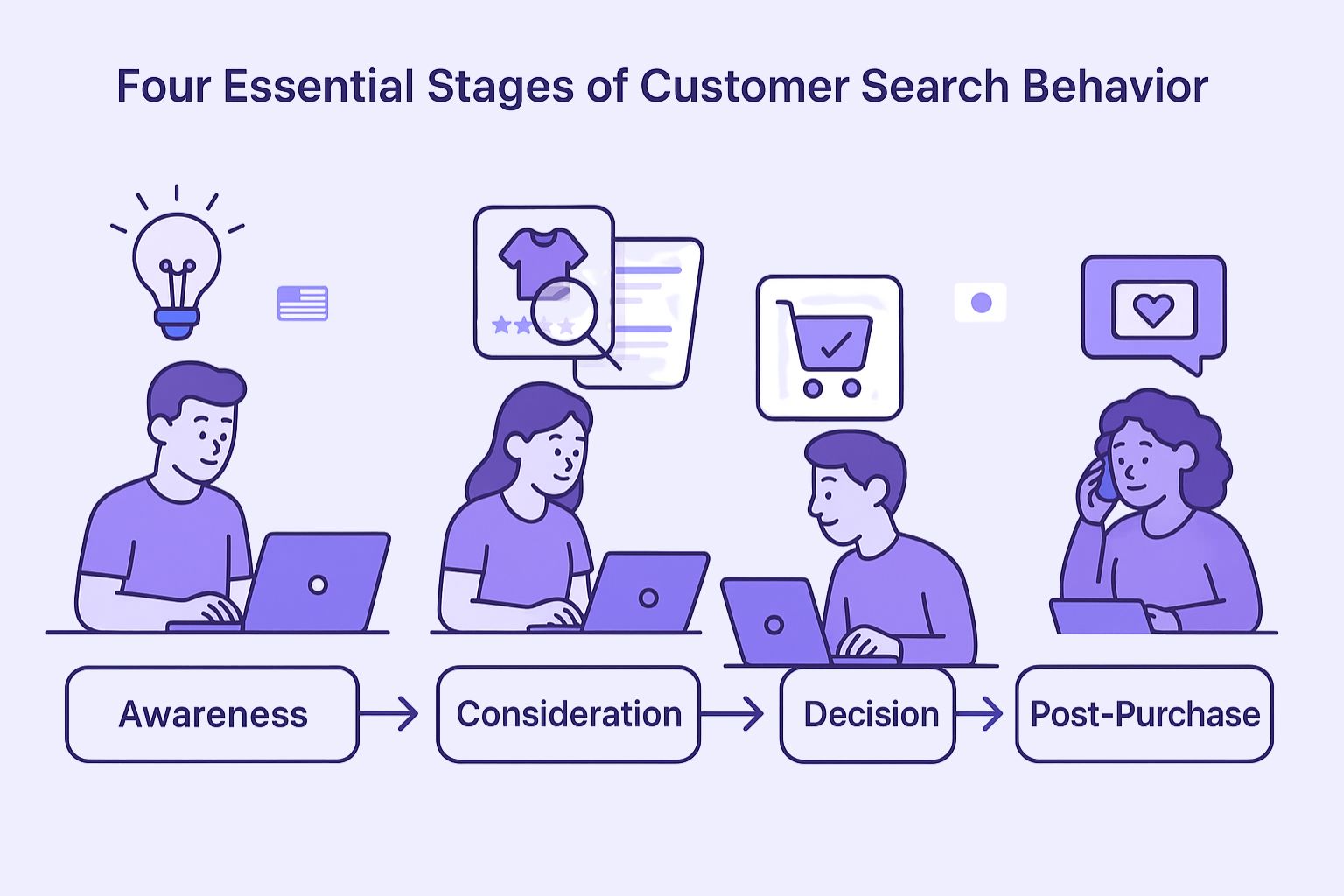
The Four Essential Stages of Customer Search Behavior
| Stage | Description | Typical Search Queries | Regional / Cultural Nuances | Key Business Focus |
| 1. Awareness Stage Need Recognition & First Search | Customers realize a need/problem and begin broad, educational searches. | “Best ways to improve posture at work”“Ergonomic solutions for office workers” | – North America: Immediate, solution-focused – Europe: General content, news, sustainability research | Create educational, customer-centric content tailored to regional expectations. |
| 2. Consideration Stage Solution Assessment & Comparison | Customers compare solutions, brands, and features, becoming more product-oriented. | “Best ergonomic chairs 2024”“Compare ideas for standing desk brands” | – Asia-Pacific: Heavy reliance on social proof & peer recommendations – North America: Prioritize efficiency & price comparisons – Sustainability & certifications valued | Provide detailed comparisons, reviews, certifications, and product-focused content. |
| 3. Decision Stage Purchase Decision & Buying Process | Customers show intent to buy with transactional queries; focus on pricing & checkout. | “Buy Herman Miller chair save 10%”“Steelcase office chair free shipping” | – Germany: Prefer invoicing & detailed specs – Australia: Local delivery options & strong after-sales support | Optimize product pages, ensure transparent pricing, and provide localized payment/shipping options. |
| 4. Post-Purchase Stage Customer Support & Re-Purchase | Focus shifts to engagement, product use, and repeat purchase opportunities. | “How to set up Herman Miller chair”“Care instructions for standing desk”“Best accessories for ergonomic chairs” | Varies by culture: Preferred communication modes & loyalty expectations | Offer strong support, loyalty programs, personalized recommendations, and localized engagement. |
Cross-Cultural E-commerce Customer Journey Differences
Cultural factors impact how consumers interact with online shopping processes. Language differences influence variation in search terms, for example, British consumers may search for “colour” and American consumers may search for “color”. While these differences may seem small and technical, the variation accumulates across the entire customer journey and impacts everything from their first blog post to their last purchase.
Requirements to build trust will vary significantly between cultures. Scandinavian customers may expect long, convoluted privacy policies and detailed company operations, whilst Latin Americans might deem personal recommendations far more valuable and accept testimonials as valid sources of information. Understanding these expectations will enable companies to tailor their strategy to have the most impact in the relevant market.
Patterns of influence from social media also differ. Customers in some Asian markets expect that social media platforms and e-commerce will be more integrated, figuring out what to buy without leaving social platforms, whereas Western markets have a clearer distinction between social and transactional experience and will prefer that an e-commerce option is a better-designed version of the platform they typically use.
Essential Customer Touchpoints in Global E-commerce
In order to map customer touchpoints in e-commerce, we must think about the diverse and complicated channels and interactions that influence how consumers shop online. Consumers today are engaging with a brand’s touchpoints on multiple platforms and/or devices before deciding whether or not to purchase, making customer touchpoint attribution difficult for businesses and therefore difficult to justify marketing spend.
Digital Touchpoints Across the Customer Journey
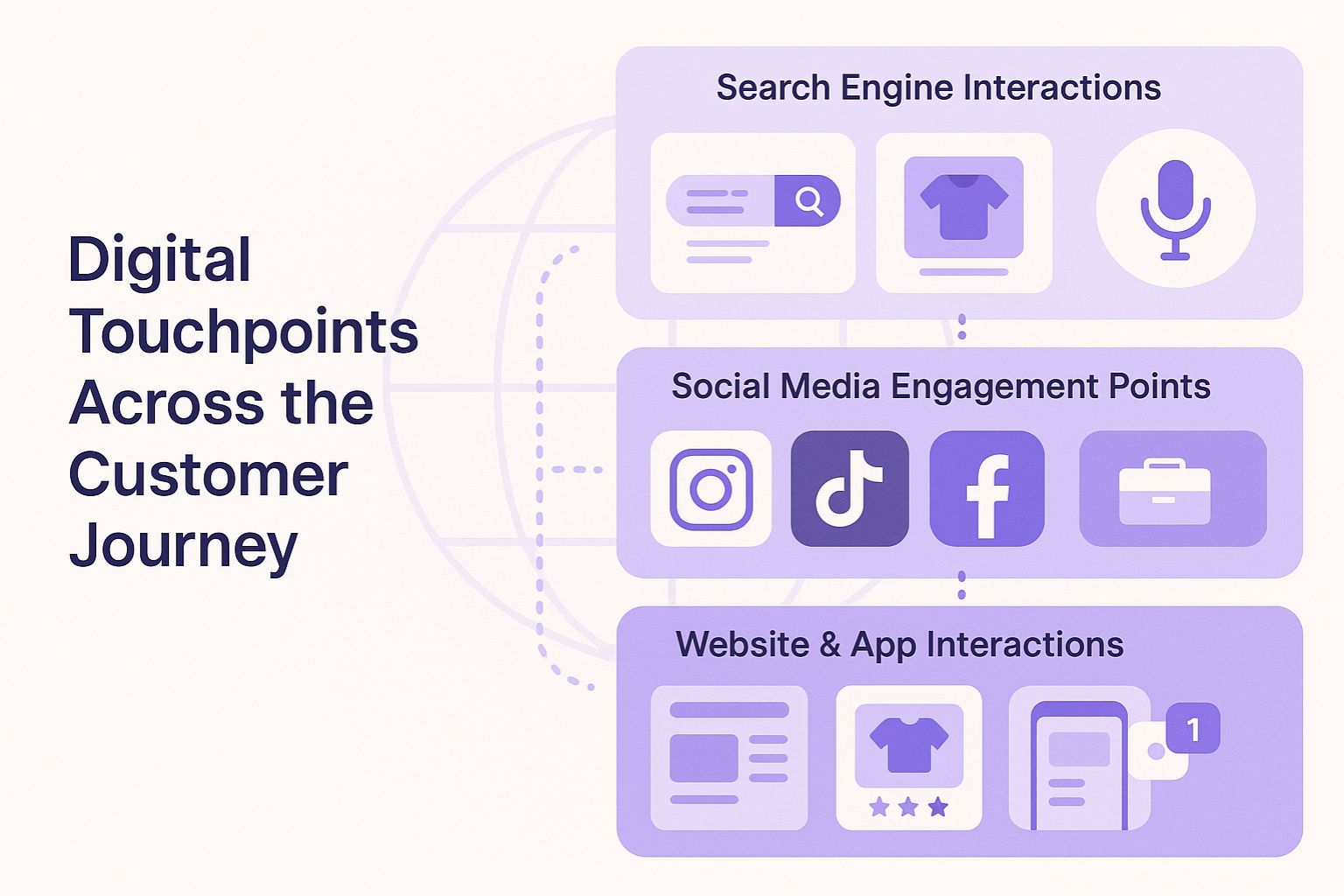
Search Engine Interactions
Search engine use is still the main WAY to find global e-commerce shoppers. On a search engine, organic search results can offer credibility and authority to your brand while paid ads can offer immediate location for a highly competitive keyword. Shopping results help facilitate all of this for the consumer by allowing them to see product information directly in the search experience. Search query transactions continue to reduce friction in the decision-making process when it comes to discovery and purchase consideration.
Social Media Engagement Points
Social media platforms serve different roles across global markets. Instagram and Pinterest drive visual product discovery, particularly for fashion, home decor, and lifestyle products. Facebook provides community-based recommendations and detailed product discussions, while LinkedIn influences B2B purchase decisions through thought leadership content.
TikTok has emerged as a powerful discovery platform for younger demographics, with short-form video content driving impulse purchases and brand awareness. Understanding platform preferences by demographic and region helps optimize social media touchpoint strategies for maximum impact.
Website and App Interactions
The navigation behavior on the website’s homepage suggests patterns of customer intent and can help you refine experiences tailored to specific market segments. Engagement with product pages, regardless of format, provides indications of content effectiveness and can help identify optimization opportunities. View and ratings consultation patterns reveal different cultural dispositions around social proof and recommendations from peers.
A mobile app interaction provides even more robust behavior data and can support personalized experiences that drive loyalty to your brand. When culturally appropriate, push notifications can help guide customers through the purchasing process and encourage repeat interactions.
Measuring Touchpoint Effectiveness Across Global Markets
Attribution modeling can be challenging, especially when analyzing customer online activity on a global scale. Old-fashioned last-click attribution does not adequately take into consideration how the new reality of customers’ multi-touchpoint pathway considers all of their travel, particularly when customers conduct research one country and purchase in another country.
Today’s advanced analytics platforms are capable of sophisticated attribution modeling to take into account cross-device behavior, elongated consideration periods, and the influence of offline touchpoints on online purchasing. You can have new insights based on these advanced analytics with more accurate measurement of ROI and reinterpretation of budget allocation between global marketing channels.
Lastly, customer journey analytics tools provide visualization of standardized paths to purchase, while also identifying opportunity to advance optimization and possible friction. Once you understand the path to purchase, you can decide what touchpoints do the most to influence your business versus your competition within the specific global market segment.
Understanding the Psychology of International Online Shoppers
The global customer search behavior psychology provides interesting discoveries that shape the influences of cultural values, economic conditions, and social norms on customer decisions when shopping online. From the customer’s initial search query to their final purchase decision and post-purchase satisfaction level, these psychological constructs affect customer behavior.
Decision-Making Factors Across Different Markets
Trust and security considerations differ widely across global markets, depending on local banking systems, regulatory environments, and cultural views toward online transactions. For example, Scandinavian countries tend to have a high amount of trust in digital payment systems, while markets with less developed e-commerce infrastructure are likely to require more security statements and alternative payment options.
Price sensitivity patterns reflect economic conditions and cultural norms that affect spending and saving. For example, German consumers frequently value durability and value more than lowest price. Price-sensitive markets like India concentrate on discounts and promotional offerings. These understandings improve pricing strategies and the messaging in promotions across varying geographies.
Brand loyalty variations across cultures also influence customer retention strategies and calculations of customer lifetime value. Japanese consumers exhibit higher brand loyalty after purchase than consumers in the United States, who are often inclined to switch brands for a better deal or upgraded features. These behaviors will affect customer acquisition costs and development of retention strategies, as examples.
Emotional Triggers and Cognitive Biases in Global E-commerce
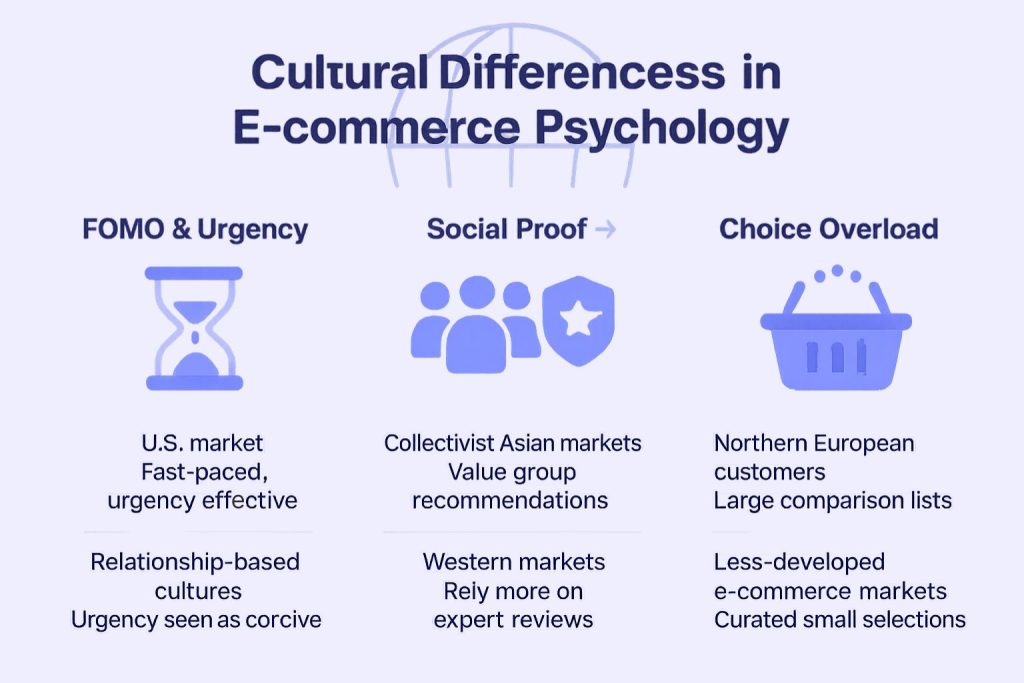
Using fear of missing out (FOMO) in your marketing requires cultural sensitivity. While urgency messages are effective in fast-paced markets like the U.S., a fast-paced messaging strategy may appear to be coercive in a culture focused on constructing relationships. Different cultures respond to emotional appeals in different ways; understanding what is or isn’t an appropriate emotional appeal can prevent cultural missteps and damage to your brand.
Markets that rely on social proof to drive behaviors are vastly different between individualistic cultures and collectivistic cultures. When driving social proof in Asian markets, the impact of group recommendations and popularity indicators seems more pronounced when compared to Western markets, which tend to rely more on recommendations from experts and specifications around product attributes before purchasing. Adapting social proof strategies to fit both the cultural preferences and expectations impacts your conversion rates and customer satisfaction.
Customers across markets interact with choice overload differently when considering the final purchase. Some global markets embrace long lists of options without issue; others prefer selections, or buckets, of curated offerings. An example of this is that Northern European customers seem to prefer exhaustive comparisons of product offerings before making a purchase while less developed e-commerce markets are likely to appetite simplified choice architectures designed to combat decision fatigue when shopping online, due to lack of experience shopping via a global e-commerce architecture.
Beginner-Friendly Tools for E-commerce Customer Journey Analysis
Getting started with customer journey analytics doesn’t require expensive enterprise software or extensive technical expertise. Several powerful, beginner-friendly tools provide valuable insights into customer behavior patterns and help optimize the online shopping experience for global audiences.
Free Analytics Platforms for Journey Tracking
| Tool | Capabilities | Key Benefits for Global E-Commerce |
| Google Analytics 4(GA4) | – Enhanced measurement features – Customizable conversion tracking – Goal funnels & conversion paths – Mobile app integration for cross-device behavior | – Sophisticated customer journey tracking – Visualizes drop-off points for optimization – Identifies international audience segments & behaviors |
| Google Search Console(GSC) | – Reveals search queries driving traffic – International targeting reports – Click-through rate (CTR) analysis – Position tracking over time | – Understands customer intent via search terms – Identifies regional performance & expansion opportunities – Measures SEO improvements across markets |
| Heatmap & User Behavior Tools (e.g., Hotjar) | – Visual heatmaps of user interactions – Click tracking – Scroll depth analysis- Form interaction tracking | – Shows what elements users engage with or ignore – Optimizes content length & structure for different markets – Identifies checkout or lead-gen friction points |
Advanced Analysis Techniques for Growing Businesses
Customer journey mapping workshops convene teams to visualize and assess the entire customer experience from different angles. Workshops help teams see where gaps exist between how they envision the customer will experience the product or service versus how customers actually experience it, which is a significant consideration when expanding into different global markets with different cultural expectations. Using insights from SEOAnt, businesses can map customer behavior and also get an understanding of search visibility touchpoints to verify that their content is in line with how international customers actually search.
To develop global market personas, it is essential to conduct research into cultural values, communication preferences, and shopping behaviors specific to the target region. Well-developed personas guide content creation, user experience design, and marketing message development to appeal to a variety of international audiences. By layering in data from SEOAnt related to keywords and search trends, businesses can create personas that are aligned with how customers behave and how different geographic locations communicate their needs via a search engine.
A/B testing for journey optimization also allows for data-driven improvements throughout the customer experience. Testing the different approaches in different segments of the market reveals cultural preferences and opportunities for optimization that probably won’t be found when analyzing general analytics. In this case, SEOAnt supports tracking the outcome of on-page SEO changes, different data metadata, and content optimization tests to provide teams with actionable evidence of what is generating better engagement and search rankings opportunities.
Implementing Customer Journey Insights for Global E-commerce Success
In order to translate an analysis of the customer journey into actual business improvement, organizations need to have a systematic approach to implementing the information they learn across their content strategy, technical foundation, and continuous optimization processes. Successful global e-commerce businesses will learn to use customer journey insights to inform their strategic planning and tactical improvements in order to systematically improve the customer experience and build a sustainable growth engine.
Content Strategy Optimization for Global Audiences
Creating Content That Matches Global Customer Journey Stages
Content in the awareness stage should address prevalent questions and problems potential customers are searching for in various global markets. This consists of blog articles with educational content, how-to guides, and industry insight, that provides expertise and builds trust with international audiences. By being culturally sensitive with content production, we can be sure our messaging resonates appropriately with the given market segment.
Content in the consideration stage emphasizes products and services through detailed comparisons, explanations of features, and situation studies that empower customers to evaluate options. Content must acknowledge regional preferences and highlight features that are more prevalent in the market. You also want to include customer testimonials from applicable geography to help build credibility and trust.
Content in the decision stage of the funnel helps eliminate the customer’s final purchase barriers, by providing clear product information, transparent pricing, and easy shopping cart process. There are times when trust signals such as certification security symbols, return policies, and seller services are essential for converting international customers with concerns about making a cross-border transaction.
Technical Implementation for Global E-Commerce Customer Journeys
Optimizing site speed becomes paramount for international audiences since load speeds can differ significantly between areas and regardless of the internet infrastructure that forms the basis for its access. Content Delivery Networks (CDNs) can be used to ensure loading times are generally fast regardless of location. In addition, image optimization and refined coding practices can help limit what must be downloaded in the way of bandwidth, so that users with slower connection speeds can get the content more quickly.
Mobile-first designs take into account that many of the international markets are more mobile than desktop or PC. Responsive design can help ensure that users will have a good experience regardless of device. Mobile-friendly features, such as one-click checkouts or digital wallet integration, can address payment methods or customs in different regions of the world.
International SEO involves issues related to implementation of the hreflang, optimizations for local keywords, or understanding the relationship between geography and preference for specific search engines. Although Google is leading in most markets, specialized optimization practices apply for areas like Russia (Yandex) or China (Baidu).
Continuous Improvement and Adaptation Strategies
Regular journey analysis and updates ensure customer experience optimization keeps pace with changing market conditions and customer expectations. Monthly analytics reviews help identify trends and seasonal patterns that affect customer behavior in different global markets.
Customer feedback integration provides qualitative insights that complement quantitative analytics data. Surveys, reviews, and direct customer communication reveal cultural preferences and pain points that might not be apparent through behavioral data alone.
Performance monitoring across markets helps identify successful strategies that can be scaled to new regions and underperforming areas that require attention. Cross-market comparison reveals opportunities for improvement and best practices that can be adapted for different cultural contexts.
Mastering Global E-commerce Customer Journeys
Understanding global E-commerce customer journeys provides the foundation for building successful international online businesses. The complexity of modern customer behavior, influenced by cultural differences, technological adoption, and regional preferences, requires sophisticated yet practical approaches to customer experience optimization.
The four essential journey stages – awareness, consideration, decision, and post-purchase – remain consistent across global markets, but the specific behaviors, preferences, and expectations within each stage vary significantly between regions. Successful businesses acknowledge these differences and adapt their strategies accordingly, rather than applying one-size-fits-all approaches that may alienate potential customers.
Cultural sensitivity in customer journey optimization extends beyond language translation to encompass payment preferences, communication styles, trust-building requirements, and decision-making processes. Businesses that invest time in understanding these cultural nuances create competitive advantages and build stronger relationships with international customers.
Immediate Action Steps for E-commerce Beginners
Start by implementing basic analytics tracking on your website to understand current customer behavior patterns. Google Analytics 4 and Google Search Console provide free, powerful insights into customer journeys and search behavior that can guide initial optimization efforts.
Conduct customer interviews or surveys to understand motivations, concerns, and preferences specific to your target markets. This qualitative research complements quantitative analytics data and reveals cultural insights that inform content and user experience decisions.
Create customer journey maps for your primary market segments, identifying touchpoints, pain points, and optimization opportunities. Use these maps to prioritize improvements that will have the greatest impact on customer experience and business results.
Focus on mobile optimization as a priority, given the high mobile adoption rates in many global markets. Ensure your website provides excellent user experience across all devices and loading conditions.
Building Long-term Global E-commerce Success
Customer journey optimization is an ongoing process that requires continuous learning, testing, and adaptation. As markets evolve and customer expectations change, successful businesses maintain flexibility and responsiveness to emerging trends and preferences.
Invest in understanding emerging technologies like voice search, artificial intelligence, and augmented reality that are beginning to influence customer journeys. Early adoption of these technologies, where culturally appropriate, can provide competitive advantages in global markets.
Build relationships with local partners and experts in target markets who can provide cultural insights and market intelligence. These partnerships help navigate complex cultural nuances and avoid costly mistakes when expanding into new regions.
Remember that mastering global E-commerce customer journeys is a journey itself – one that rewards patience, cultural sensitivity, and commitment to continuous improvement with sustainable international growth and success.
Frequently Asked Questions About E-commerce Customer Journeys
What is the e-commerce customer journey?
The E-commerce customer journeys is the complete process a customer goes through from recognizing a need to making a purchase and beyond. It includes all touchpoints and interactions between the customer and your brand across multiple channels and devices, typically spanning awareness, consideration, decision, and post-purchase stages.
How do customers behave when shopping online?
Online customer behavior varies significantly across global markets, but generally includes extensive research, price and feature comparisons, review reading, and multi-device browsing before making purchase decisions. Modern customers often interact with brands across multiple touchpoints before converting, making the journey complex and non-linear.
What are the stages of online customer journey?
The online customer journey typically includes four main stages: 1) Awareness (recognizing a need), 2) Consideration (researching and comparing solutions), 3) Decision (choosing and purchasing), and 4) Post-purchase (support, reviews, and repeat purchases). Each stage requires different content and optimization strategies.
Why is customer journey mapping important for e-commerce?
E-commerce customer journeys mapping helps businesses understand customer needs, identify pain points, optimize touchpoints, and create more effective marketing strategies. For global e-commerce, it’s essential for understanding cultural differences and adapting strategies for different international markets to improve conversion rates and customer satisfaction.
Shopify Store SEO: How Search Engines View Your Store in 2026
The Invisible Store Problem Every Shopify Owner Faces
Imagine this: after dedicating weeks to meticulously building your Shopify store, carefully selecting products, designing great product layouts, and crafting compelling product descriptions, you launch your store with enthusiasm, expecting customers to discover your amazing products! Then, cricket sounds. Your analytics demonstrate that most traffic comes from you, and your organic search traffic registers as single digits. If so far this sounds familiar, you are not alone! New Shopify store owners often see fewer than 100 organic visitors within 2-3 months of launching their store, not because there is no demand for their products, but simply because the search engines do not know how to organize and market their stores to prospective customers due to lacking of strategic Shopify Store SEO.
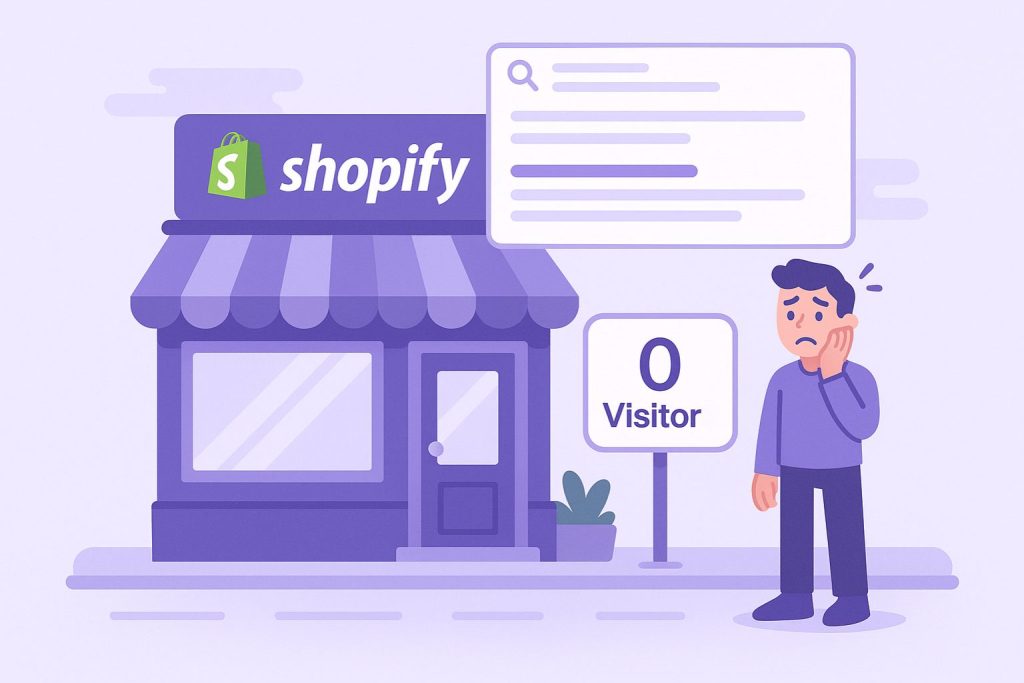
Here is the truth: search engines like Google are processing over 8.5 billion searches every single day, and most Shopify store owners are completely invisible in these very relevant, very valuable search results. The difference between a store that is successful, and a store that struggles, is not because successful stores have better products or prices, the difference is understanding the context in which search engines use to define and categorize shopify store content, and then prioritize relevant store content.
In this easy-to-follow Shopify SEO guide you will learn exactly how search engines find, evaluate, and rank your Shopify store. More importantly, you will be introduced to practical ideas that will change your Shopify store from being invisible to discoverable, and then attract qualified customers to your store, as a natural process. This Shopify SEO for beginners journey focuses on understanding what is technically required, rather than worrying about how much time and effort it would take to set-up.
Understanding How Search Engines Discover and Evaluate Your Shopify Store
Think of Search Engines as Digital Librarians
To understand search engine optimization shopify success, think of search engines as very effective digital librarians, keeping the best library – the world’s largest library. So, these librarians not only don’t just put books on shelves, they take into account cataloging (organizing), helping you find the books you need, and recommending the best resources for you.
When you walk into the library and ask the librarian (search engine) where the “comfortable running shoes for flat feet” are: the librarian must quickly find the most helpful, legitimate and useful information – after all, there are millions of books to search from. When you think of your Shopify store as just one book in that library, consider how well the librarian understands your book (your store, it’s purpose) and uses their resources (knowledge and experience) to categorize your book.
Think of it this way: when librarians are referencing books as a resource (and assuming they are a competent, responsible librarian), they are referencing the content quality of the book (what’s inside), the authors credibility (who is behind it) and reader usefulness (would this useful for a reader that asks: “where are the comfortable running shoes for flat feet”.).
Similarly: search engines look at the quality of your product description, your reputation (the business), and your satisfaction, to determine how, when and how much to recommend to their users.
Understanding this perspective is really important for Shopify SEO for beginners, as the thought process shifts from “gaming algorithms” to genuinely useful value that search engines can quickly understand and can confidently refer their users to.
The Three-Step Discovery Process: Crawling, Indexing, and Ranking
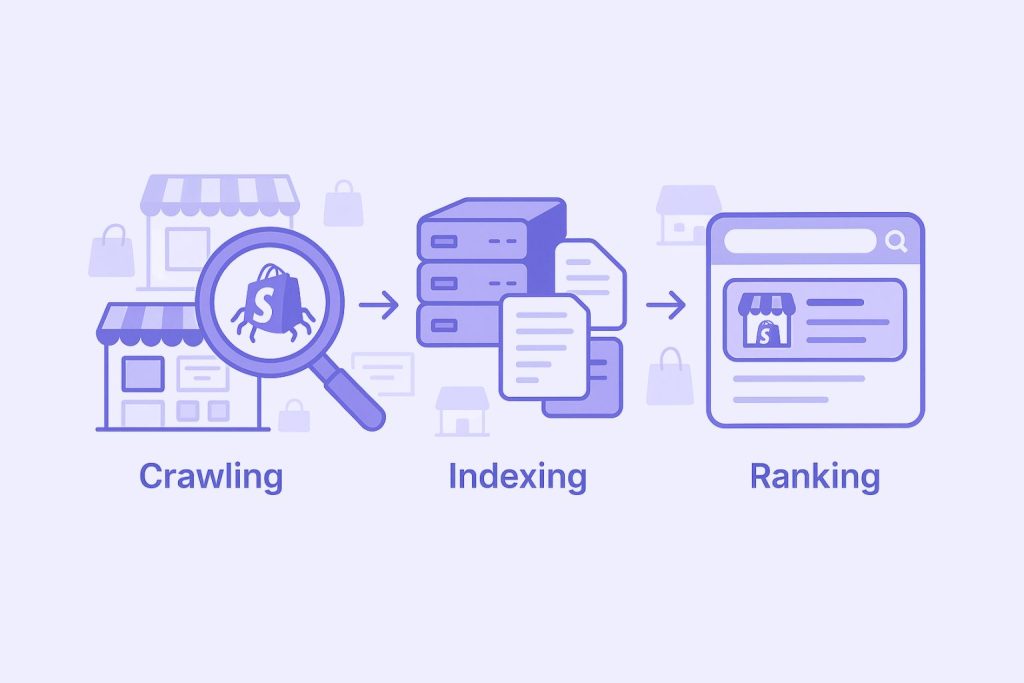
Search engines evaluate your Shopify store through a three-step process: crawling, indexing, and ranking. Each stage plays a critical role in how easily customers can discover your products online. Understanding search engine crawling requires grasping three distinct phases that determine your store’s visibility. Each phase presents unique opportunities and challenges for Shopify store owners.
| Step | What It Is | How It Works | Why It Matters for Shopify Stores |
| Crawling: The Digital Store Visit | Search engines send automated programs (crawlers/spiders) to explore your store. | Crawlers follow links from homepage to product pages, collections, blogs, etc., checking site structure, load times, and navigation. | A clear site architecture ensures all pages are discoverable. Broken links or confusing navigation can block crawlers, leaving pages unseen. |
| Indexing: Building Your Store’s Digital Profile | Search engines store and organize information about your pages in their databases. | Unique, descriptive content helps search engines understand what each page offers and how it fits into your store. | Poor indexing (due to duplicate or thin content) reduces visibility. Shopify’s technical SEO setup plays a key role in accurate categorization. |
| Ranking: The Recommendation Algorithm | Search engines decide when and where your store appears in results. | They weigh hundreds of factors like relevance, authority, speed, mobile optimization, reviews, and business credibility. | Stores that focus on user experience, quality content, and trust signals rank higher and attract more targeted traffic. |
What Search Engines Actually See When They Visit Your Store
Site Structure: Your Store’s Blueprint
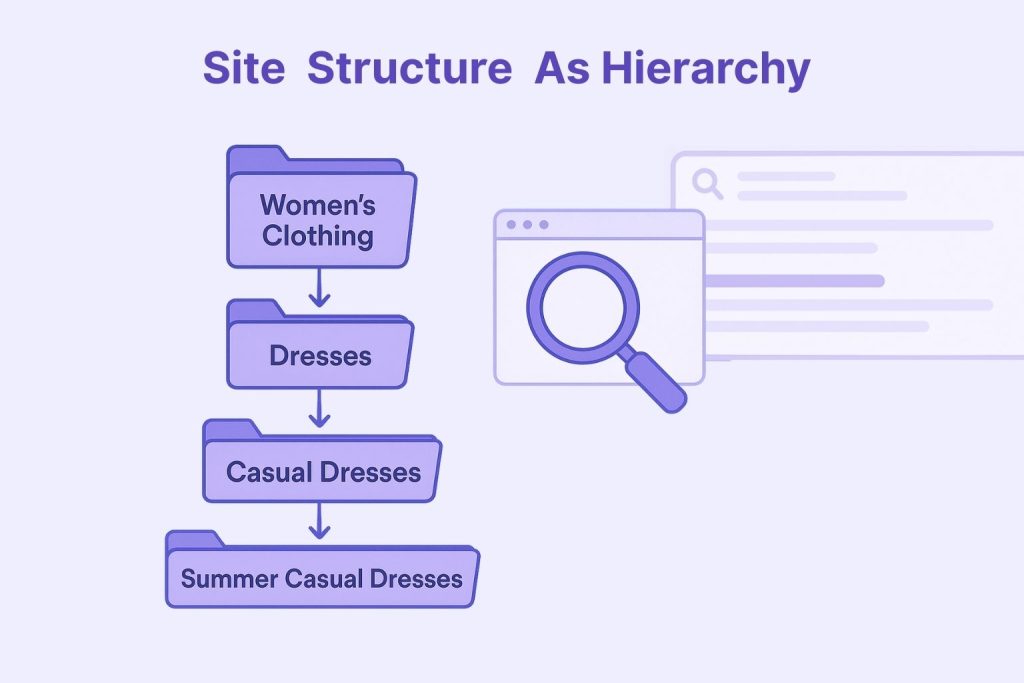
When the search engines analyze shopify site structure they are basically examining your store’s blueprint and understanding how the content pieces relate to each other and also how the content flows logically. This is as important as anything else because it literally impacts how well search engines can associate your products to customer searches.
Search engines prefer logical, hierarchical structures that can identify with users thinking. For example, a clothing store might be organized like this, Women’s Clothing →Dresses → Casual Dresses → Summer Casual Dresses. This provides a lot of context to the search engines and they know exactly what the page is about and when to show it.
Your navigation structure will provide search engines with direction just like a map. Clear category organization, detailed descriptions in the menu items and related products organized together help search engines understand the focus of your business but also how products relate to one another. If your store is all over the place and has no organization or clear navigation the search engine will be confused, which can limit search visibility.
URL structure significantly impacts shopify store search visibility because URLs provide immediate context about page content. Descriptive URLs like “/collections/organic-baby-clothes” communicate clear information, while generic URLs like “/collections/products-123” offer no helpful context for search engine understanding.
Internal linking between related products and categories strengthens site architecture by showing search engines how your content connects. Strategic linking helps distribute authority throughout your store while providing additional context about product relationships and category hierarchies.
Content Elements Search Engines Evaluate
Beyond technical structure, search engines carefully analyze the actual content that defines your store’s value proposition and customer relevance.
| Factor | What Search Engines Evaluate | Why It Matters |
| Product Information Quality | – Uniqueness, detail, and value of product descriptions – Comprehensive details (materials, dimensions, use cases, care, benefits) – Image optimization with descriptive alt text and file names | – Original, detailed descriptions outperform generic manufacturer copy – Rich content improves customer decision-making and rankings – Optimized images boost both visibility and user experience |
| Store Credibility Signals | – Complete business details (contact info, return policies, security badges) – Professional design elements- Customer reviews and testimonials – Consistency across Google My Business and other platforms | – Builds trust with customers and search engines – Authentic reviews provide strong social proof – Consistent business info helps verify legitimacy and local relevance |
| Content Freshness and Updates | – Regular updates (new products, updated descriptions, blog posts, seasonal changes) – Targeting trending keywords and seasonal search terms – Accurate inventory management and product availability | – Signals active business management and relevance – Fresh content improves rankings on trending/seasonal searches – Updated inventory prevents negative SEO impact from stale info |
Common Shopify Store SEO Misunderstandings That Limit Growth
In the pursuit of growing a Shopify store, many merchants often find themselves in common SEO traps that silently restrict their visibility. Misconceptions about how Shopify SEO really works can create a false sense of confidence while leaving a vast array of opportunities on the table. By debunking these myths, store owners can focus on the tactics that generate sustainable search growth.
Myth 1: Shopify Handles All SEO Automatically
Numerous store owners think that Shopify takes care of everything SEO related, but in fact, it limits itself only to the technical part, providing you with a lot of the technical aspects already set up for you (eg. sitemaps, mobile responsive, hosting speed, SSL etc.). Visibility in the search engine results pages is only created through the hard work of search engine optimization involved in writing product descriptions, finding keywords that fit your product range, and writing quality content. Shopify is like owning a professional camera; just because you own a professional camera doesn’t mean you’ll have great results, and we would still expect someone to use skill and strategy.
Myth 2: SEO Apps Solve Everything
Another common misconception is that adding SEO apps improves your shopify search engine visibility. While decent apps can give you useful tools or automate certain aspects of your SEO, they aren’t a substitute for a basic understanding of the principles of search engine optimization.
SEO apps usually complement manual optimization rather than replace it. Apps can do great things like bulk edit meta tags, compress images, and conduct technical audits, but they can’t create content strategies, or develop authentic customer relationships that lead to long-term success.
You should always develop a basic understanding of Shopify Store SEO and create optimization processes manually first before you install any app. Doing this ensures that your processes are founded in your basic SEO knowledge so that you can understand how any app’s processes will either add value to your business or constantly be referred to as a solution when you can use optimization processes that you have developed and structured for your specific business purposes.
Myth 3: More Products Equal Better Shopify Store SEO Performance
Store owners may believe that more products means better SEO but search engines prefer quality instead of quantity. A small catalog with optimized descriptions, keywords, images and categories will outperform a large poorly optimized store every time. Always focus on adding products strategically with care, based on research and demand, that improves growth without reducing optimzatrion practices.
Simple Changes That Improve How Search Engines See Your Store
Quick Wins You Can Implement Today
Understanding search engine optimization principles becomes actionable through specific improvements that immediately enhance how search engines perceive and categorize your Shopify store.
Basic Settings Optimization
Start with your store’s essential settings that provide search engines with the critical business context they need. In Shopify admin’s Preferences look at your store title and meta description- these appear on search results and impact your click through rate. Your title should clearly say what your business is and/or the keywords you are focused on (without being overly spammy, i.e. Sustainable Home Goods | Eco-Friendly Kitchen and Bath Products). Meta descriptions should be write as short pitches full of value with built in keywords that flow with great reasonable. Lastly, make sure your contact page is filled out with accurate information as well as your hours of operation, phone number, email and address. All of these details can help build credibility with back search engines and give added local relevance.
Product Page Quick Fixes
Review your top-selling products and identify optimization opportunities that require minimal time investment but deliver substantial impact on Shopify store SEO optimization. Product titles should balance keyword optimization with customer clarity. Include primary product keywords while maintaining natural language that customers would use when searching. “Women’s Waterproof Hiking Boots – Size 6-11” works better than “Boots Women Waterproof Hiking Outdoor Footwear.”
Evaluate product descriptions for uniqueness and detail level. If you’re using manufacturer descriptions, rewrite them to reflect your brand voice while addressing customer questions and concerns. Include specific details about materials, sizing, care instructions, and use cases that help customers make informed decisions. Add descriptive alt text to product images using natural language that describes the image content. “Woman wearing black waterproof hiking boots on mountain trail” provides better context than “hiking-boots-product-image-1” while incorporating relevant keywords organically.
Technical Health Check
Verify that your sitemap is properly submitted to Google Search Console. Navigate to search.google.com, add your store if not already added, and submit your sitemap (typically yourstore.myshopify.com/sitemap.xml). Test your store’s mobile performance using Google’s Mobile-Friendly Test tool. Since most customers browse on mobile devices, mobile optimization directly impacts search rankings and customer experience quality. Check basic page loading speed using Google PageSpeed Insights. While you may not be able to make dramatic improvements immediately, understanding your current performance establishes baseline metrics for future optimization efforts.
Building Long-term Search Success
Sustainable shopify store search visibility requires ongoing effort focused on content creation, customer engagement, and performance monitoring that builds authority over time. To build long-term SEO success, you need more than technical fixes—you need a well-rounded strategy that covers content, customer trust, and performance tracking. The table below highlights three core areas every Shopify store should prioritize for sustainable growth.
| Strategy | Key Actions | Why It Matters |
| Content Strategy Development | – Publish blogs, buying guides, and educational material – Build a content calendar aligned with seasons, product launches, and customer trends – Focus on customer pain points, product knowledge, and insights | – Attracts links and authority – Targets wider keyword clusters – Demonstrates business activity – Builds trust and long-term customer relationships |
| Customer Review Strategy | – Create processes to collect reviews from happy customers – Respond professionally to all reviews (positive or negative) – Use feedback to improve products and content targeting | – Reviews provide social proof – Enhances product page SEO with fresh content – Builds trust with customers and search engines – Reveals customer concerns for keyword and content optimization |
| Performance Metrics | – Use Google Analytics & Search Console to track organic traffic, rankings, and buying behaviors – Track competitors with SEMrush or Ahrefs to spot trends and content gaps – Focus on conversion rates from organic traffic | – Identifies what works and what doesn’t – Uncovers industry best practices – Helps refine strategies continuously – Connects SEO efforts directly to business growth |
Your Journey from Invisible to Discoverable
Having an insight into how search engines view shopify store content and architecture is the first step to developing a sustainable search visibility strategy that will foster real, qualified traffic and customer growth. The journey from invisible to discoverable is not overnight but through systematically optimizing you can create momentum, allowing for compounded, long-term growth. Ultimately, search engines merely serve customer needs by linking them to businesses that provide real value and experience. Therefore, if you prioritize customers, product quality and service quality, you will engage with the goals of the search engines while developing sustainable business success.
Start with one immediate action today: Choose your highest-priority product and spend 30 minutes optimizing its title, description, and images using the principles outlined in this guide. This single optimization will demonstrate how understanding search engine perspectives translates into practical improvements that enhance both search visibility and customer experience.
The journey from confusion to clarity in Shopify store SEO for beginners begins with understanding rather than overwhelming technical implementation. Build on this foundation by consistently applying optimization principles, monitoring performance results, and expanding your knowledge through experimentation and continuous learning. Success in search engine optimization comes from patience, consistency, and focus on long-term value creation rather than quick fixes. Start building your search visibility today, one optimization at a time, and watch your store transform from invisible to indispensable in your customers’ online shopping journeys.
What is Shopify SEO? The Complete SEO Checklist (2026 Update)
Why Shopify SEO Drives Global E-commerce Success?
Did you know that 68% of online experiences begin with a search engine, yet 75% of Shopify stores worldwide struggle with basic SEO implementation? Whether you’re launching a tech startup in Silicon Valley, a sustainable fashion brand in London, or a surf accessories store in Sydney, this statistic should grab your attention immediately.
Shopify SEO is not just a marketing strategy; it’s the bedrock on which to build your store accessibility, so that customers around the world can find you. With 2.77 billion people shopping online in 2025, and over 5.5 million Shopify merchants, if you do not have a proper SEO optimization strategy no one will see you.
Advertising costs are exponentially increasing, leaving ad revenue short. Shopify SEO offers a long-term sustainable growth opportunity. By learning e-commerce SEO, you will earn the ability to outrank your competitors, reach customers around the globe, and reduce your reliance on paid advertisements.
In this Shopify SEO Checklist, you’ll discover:
– What Shopify SEO actually means and why it’s crucial for global success
– How search engines evaluate and rank your Shopify store worldwide
– Practical steps you can implement immediately, regardless of your location
– Common mistakes that cost store owners thousands in lost revenue
What is Shopify SEO?
Shopify SEO is the act of optimizing your Shopify store so it appears higher on Google’s, Bing’s, and other search engines’ products. No matter if a customer searches in New York, London, Toronto, or Sydney, Shopify SEO makes your products appear prominently in the results. It’s like having the best spot on the busiest street – except the “street” is the internet and your “spot” is your search ranking.
E-commerce SEO vs Regular SEO: Key Differences Explained
SEO for Shopify is quite different than SEO in the general web space. For starters, store owners are often overwhelmed by the number of products they sell and must optimize many hundreds or thousands of product pages.
| Shopify SEO | General Website SEO | |
| Content | Often involves optimizing hundreds or thousands of individual product pages. | Typically focuses on a smaller number of core pages, blog posts, and landing pages. |
| Intent Focus | Targets shopping intent — attracting customers ready to buy. | Targets a mix of informational, navigational, and transactional searches. |
| Competition | Competes with both independent stores and large marketplaces like Amazon, eBay, and local leaders. | Competes mainly with other websites in the same niche or industry. |
| Seasonality | Must account for promotional and inventory cycles that affect visibility and sales. | Seasonality may be less pronounced depending on industry. |
Why SEO is Critical for Global E-commerce Success
SEO is not only a sandbox, but it’s also where visibility begins. In 2025, approximately 68% of all online experiences begin with search engines. 53.3% of all website traffic is derived from organic search and is the largest driver of sustainably-generated traffic (Source: Intergrowth). Search engines remain the primary access point to discovery, with over 90% of clicks occurring on the first page of results and only 0.63% of users clicking on page 2. Performance is important too—the first organic result, number 1, generates nearly 39.8% of all clicks. Winning that first position is a huge traffic lever. What’s great about SEO? That long-term equity: SEO compounds results over time and creates momentum, credibility, and ROI that cannot be created through paid ads.
How Search Engines Rank Your Shopify Store
Google Ranking Factors for Shopify Stores
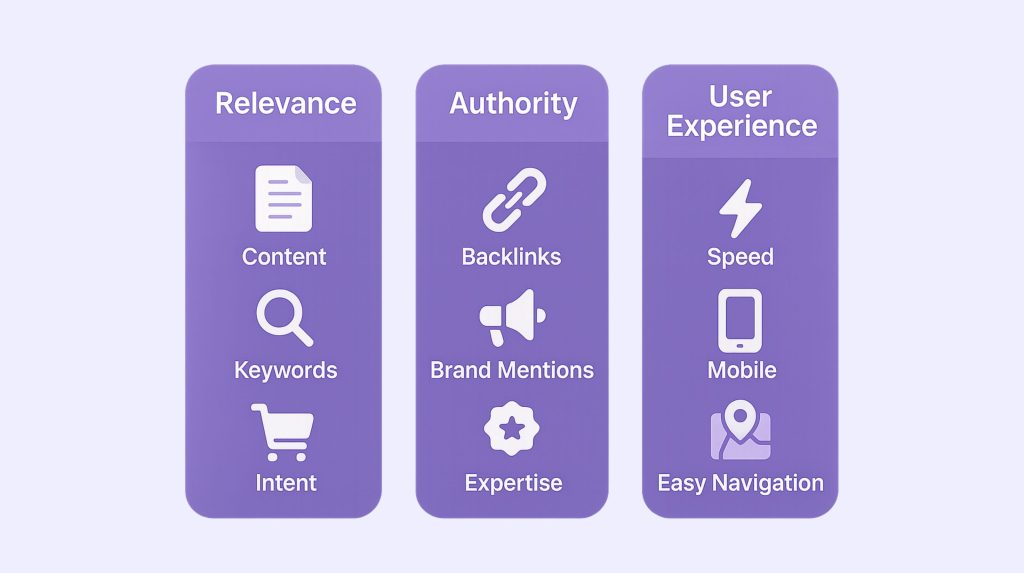
Search engines evaluate your Shopify store based on three primary factors that remain consistent globally:
1. Relevance: Does your content match what searchers want?
– Content Quality: Comprehensive, helpful product information
– Keyword Targeting: Natural use of terms customers actually search
– User Intent: Matching content to different stages of the buying journey
2. Authority: Can search engines trust your store?
– Backlinks: Other reputable websites linking to your store
– Brand Mentions: Recognition across the web and social media
– Expertise: Demonstrating knowledge in your product category
3. User Experience: Do visitors have a positive experience?
– Page Speed: Fast loading times across all devices
– Mobile Optimization: Seamless mobile shopping experience
– Navigation: Easy-to-find products and information
Regional Search Engine Considerations
While Google dominates globally (89.66% market share), regional preferences matter:
Regional Search Engine Market Share in 2025:
| Country/Region | Bing | Yahoo | Others | |
| United States | 86.83% | 7.56% | 2.8% | 2.23% |
| United Kingdom | 93.35% | 4% | 1.39% | 0.69% |
| Canada | 89.5% | 6.55% | 2.04% | 1.34% |
| Australia | 94.57% | 2.74% | 0.82% | 1.87% |
E-commerce Specific Ranking Factors
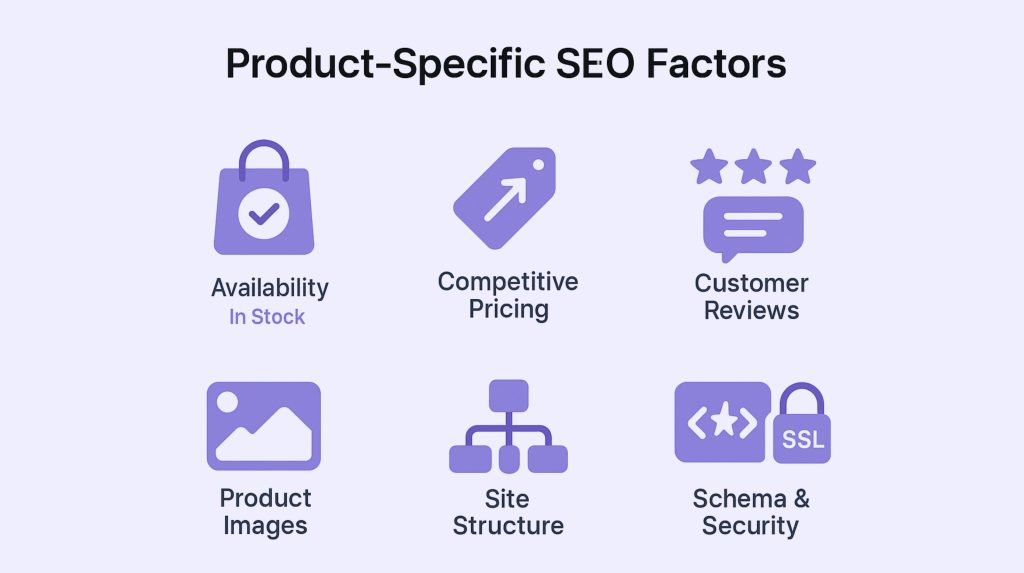
On the product-specific side of things, availability is critical – items that are available will achieve a better ranking than items that are not in stock. Competitive pricing could improve visibility in search results – search engines want to serve you attractive results. Customer reviews function as trust signals that can affect both click-through rates and ranking. Great product images provide a quality experience. They offer some SEO benefit by improving engagement and conversion.
From a technical perspective, your site structure is important. Good categorization and navigation will allow users, and search engine crawlers, to understand the content of your store and the hierarchy of your site. Implementing schema markup (including structured product data), can help you achieve rich snippets of results (including star ratings or prices) that can elevate your visibility and improve Click-Through-Rates in the search results. Security features such as SSL certificates and secure checkout are both useful to users and improve SEO credibility.
Shopify SEO vs. Other Platforms
Platform Capabilities Comparison
Understanding how Shopify compares to other e-commerce platforms helps contextualize your SEO advantages and limitations:
Shopify SEO Advantages
– Automatic Technical SEO: XML sitemaps, robots.txt, SSL certificates handled automatically
– Mobile Optimization: Responsive themes and mobile-first approach by default
– Global Infrastructure: CDN and hosting optimized for international performance
– Multi-Currency Support: Built-in currency conversion with SEO considerations
– App Ecosystem: Extensive SEO app marketplace for specialized needs
Shopify SEO Limitations and Solutions
Limitations:
E-commerce platforms like Shopify offer ease of use but come with restrictions. You have limited technical control, meaning server configurations and advanced settings can’t be modified. SEO performance often depends on your theme, and URL structures may lack full customization. Additionally, the platform’s setup can lead to duplicate content issues.
Solutions:
Use SEO apps to enhance functionality, and select SEO-optimized themes from trusted developers. Prioritize a strong content strategy with unique, high-value pages. For more complex needs, seek expert support from certified Shopify Partners.
Getting Started: Your First Steps to SEO Success
Shopify SEO Audit: Quick Assessment
Before implementing any SEO strategies, understand your current position:
Quick SEO Health Check:
1. Google Your Business Name: Do you appear in the first 3 results?
2. Check Mobile Experience: How does your store look on a smartphone?
3. Test Site Speed: Use Google PageSpeed Insights to check loading time
4. Review Current Traffic: Check Shopify analytics for organic search traffic
5. Analyze Top Pages: Identify which pages currently get the most visits
Global Competitive Research:
– Search for your main products in your target markets
– Note which competitors appear in top 5 results
– Analyze their approach: pricing, descriptions, images, content
– Identify content gaps and opportunities
Shopify SEO Setup: Essential Technical Foundations
Technical Setup Checklist:
– Google Analytics Setup: Install GA4 for traffic tracking
– Google Search Console: Verify your domain and submit sitemap
– Business Information: Complete store name, description, and contact details
– SSL Certificate: Ensure your store uses HTTPS (Shopify provides this automatically)
– Mobile Responsiveness: Test your store on multiple device sizes
Common Shopify SEO Mistakes: What Beginners Must Avoid
| Mistake | Impact | Solution |
| 1. Keyword Stuffing Across All Markets | Search engines penalize over-optimization, reducing rankings | Use keywords naturally and include semantic variations |
| 2. Ignoring Mobile Experience Globally | Mobile-unfriendly stores lose 53% of potential customers; 58% of e-commerce traffic is mobile | Test and optimize every page for mobile responsiveness |
| 3. Copying Manufacturer Descriptions | Duplicate content is filtered out by search engines; poor local engagement | Write original, benefit-focused descriptions; localize for regional language and preferences |
Global Shopify Setup: Market-Specific Configuration Tips
Cultural sensitivity mistakes in global SEO can significantly harm store performance. In the US, brands often over-promise or ignore regional differences like those between Texas and California, while failing to prioritize mobile optimization. In the UK, aggressive sales language, GDPR non-compliance, and neglecting post-Brexit preferences are common pitfalls.
The Canadian market values sustainability and bilingual content, so overlooking these, along with unclear cross-border policies, can alienate users. Meanwhile, in Australia, mobile-first design is essential, and businesses must align with southern hemisphere seasons and address vast shipping distances. Tailoring strategies to each region’s culture and expectations is crucial for success.
Technical Mistakes with Global Impact
1. Slow Loading Speeds
– Global Standard: Pages should load in under 3 seconds worldwide
– Regional Expectations: US (2.5s), UK (3.2s), Canada (3.0s), Australia (2.8s)
– Impact: 53% of mobile users abandon slow sites globally
– Solution: Optimize images, choose fast themes, use apps judiciously
2. Poor URL Structure
– Mistake: Using generic URLs like “/products/product-12345”
– Better Approach: Descriptive URLs like “/products/wireless-bluetooth-headphones-black”
– Global Benefit: Improves understanding across all search engines and cultures
– Solution: Edit product URLs to include relevant keywords
3. Missing Meta Descriptions
– Mistake: Leaving meta descriptions blank or using defaults
– Impact: Reduces click-through rates from search results globally
– Solution: Practice and implement writing your meta title, meta description as well as other meta tags
Shopify SEO Implementation: Your 90-Day Global Roadmap
Here’s a clear, phased roadmap to guide your Shopify store SEO implementation—organized by timeline so you know exactly what to focus on at each stage.
| Phase & Timeline | Focus Area | Key Actions |
| Phase 1: Immediate Actions (Week 0–1) | Technical Foundation | – Set up Google Analytics 4 for tracking – Add Google Search Console & submit XML sitemap – Audit homepage, top 5 products, and About page – Run mobile speed testIdentify top 3 competitors in your main market |
| Quick Content Wins | – Optimize homepage title (keyword + value prop) – Refine top product titles with keywordsWrite compelling meta descriptions for main pages – Add descriptive alt text to top product images – Update About page to build trust | |
| Phase 2: Week 1–2 | Content Development | – Conduct keyword research (20–30 high-intent terms) – Rewrite top 10 product descriptions with unique copy – Plan 5 helpful blog articlesCreate FAQ page – Adapt content for local markets |
| Technical Optimization | – Compress images & optimize site speed – Test full mobile checkout experience – Connect related products & categories with internal links – Add schema markup for rich snippets – Ensure sitemap includes all important pages | |
| Phase 3: Month 1–3 | Advanced Content Strategy | – Launch blog (2–3 articles/month) – Develop regional content variationsImplement review collection & optimization strategy – Produce product demo/how-to videos – Plan seasonal campaigns |
| Performance & Growth | – Set up conversion tracking & goals in analytics – Monitor keyword rankings by market – Begin quality link-building outreach – Align social media with SEO efforts – Continuously test & refine strategies |
Success Metrics to Track
And don’t forget to measure your work—tracking the right metrics ensures you know what’s working, what’s not, and where to focus next.
| Traffic Metrics | – Organic sessions – Keyword rankings by market – Geographic traffic distribution – Mobile vs. desktop performance |
| Engagement Metrics | – Average Session Duration: Time spent on site from organic traffic – Bounce Rate: Percentage of single-page visits – Pages per Session: Content consumption depth – Return Visitor Rate: Customer loyalty and content value |
| Conversion Metrics | – Organic Conversion Rate: Percentage of organic visitors who purchase – Revenue from Organic: Sales directly attributed to SEO efforts – Average Order Value: Purchase size from organic traffic – Customer Lifetime Value: Long-term value of SEO-acquired customers |
Frequently Asked Questions
1, What is Shopify SEO and why should I care?
Shopify SEO simply is when you optimize your e-commerce store so that your store ranks higher in search engine results when potential customers search for your products (online). You should care because 68% of all online experiences begin with a search engine, and businesses that have exceptional SEO don’t need to pay for advertisements to get significantly more customers.
2, How long does Shopify SEO take to work?
SEO work might begin to yield results within 4-8 weeks – when you implement new content and make improvements. Typically you’ll see significant growth in traffic within months 3-6. The full potential of SEO generally occurs after 6-12 months, as your store builds authority and search engines understand that the store is taking steps for optimization.
3, What are the costs involved in Shopify SEO?
Basic SEO can be done for free using Shopify’s built-in features and free tools like Google Analytics. Professional Shopify SEO apps cost $10-50/month, while hiring SEO experts ranges from $500-2,000/month depending on your market and needs. Most beginners can start effectively with $50-100/month in tools and apps.
4, Is Shopify good for SEO compared to other platforms?
Yes, Shopify provides excellent SEO foundations with automatic technical optimization, mobile-friendly themes, and global performance. While platforms like WordPress offer more technical control, Shopify’s built-in features and ease of use make it ideal for businesses focused on selling rather than technical management.
5, Can I do Shopify SEO myself as a beginner?
Absolutely! Shopify is designed for non-technical users, and basic SEO requires no coding knowledge. Focus on creating quality content, optimizing product descriptions, and following best practices. As you grow, you can add advanced techniques or hire experts for complex strategies.
Final Words
Remember: SEO is not a one-time setup but an ongoing process of improvement and adaptation. The most successful Shopify store owners treat SEO as a core business function, dedicating consistent time and effort to optimization while staying focused on serving their customers’ needs.
Ready for the next level?
Dive into “Shopify Store SEO: How Search Engines View Your Store in 2026″ – Understand exactly how Google and other search engines evaluate and rank your store